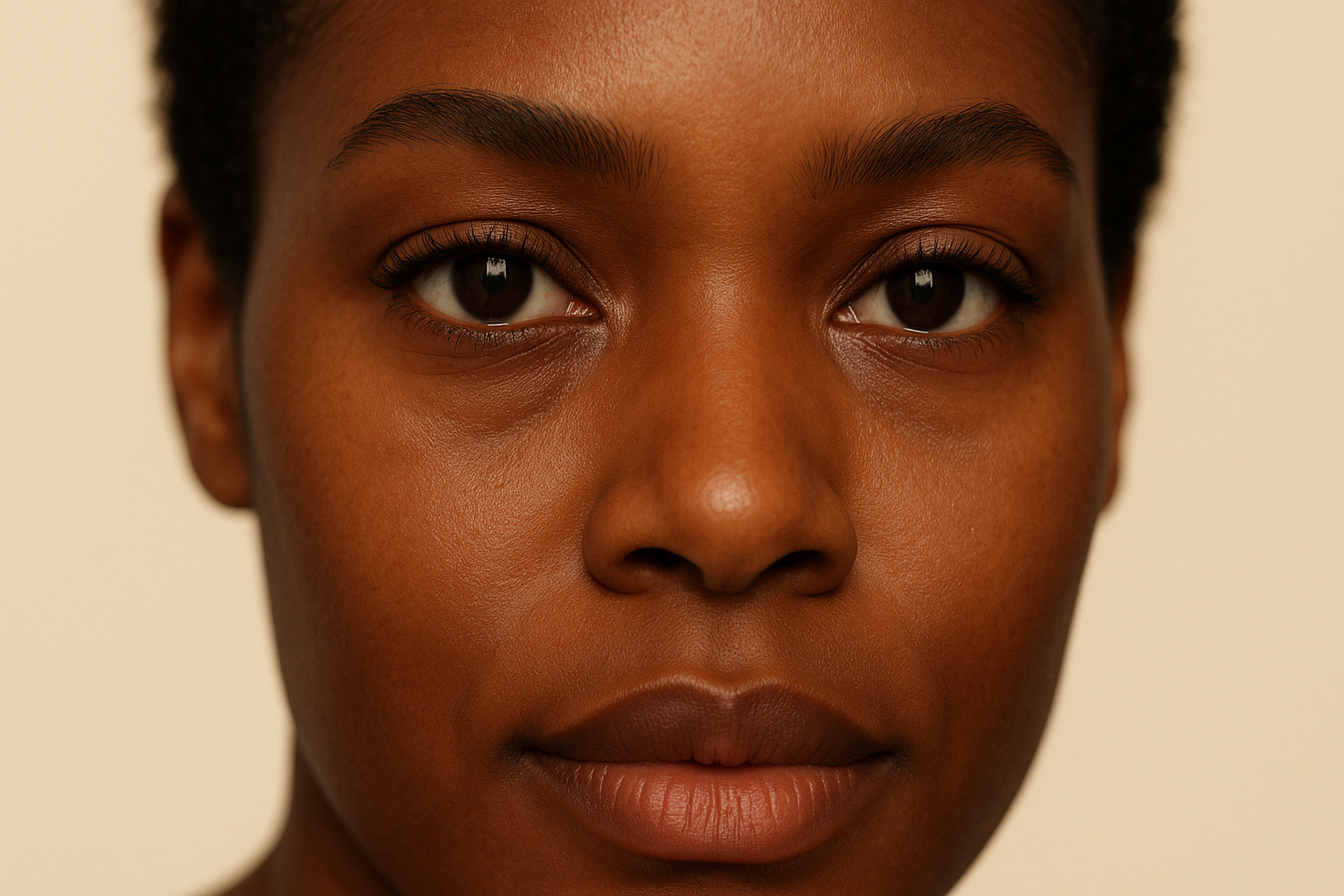
Post-acne marks come in two forms. They look almost identical at a glance. They need completely different treatments. Most skincare advice — and most skincare apps — collapse them into a single "hyperpigmentation" or "acne marks" finding. That's why so many treatment plans fail: half the marks aren't responding to the brightening agent because they're not pigment, they're vascular.
What is the difference between PIH and PIE?
PIH (post-inflammatory hyperpigmentation) is brown or warm-brown marks left after inflammation, caused by melanin deposition.
PIE (post-inflammatory erythema) is pink or red marks left after inflammation, caused by dilated blood vessels close to the skin surface.
Both look like marks left over after a breakout, but they have completely different causes and need completely different treatments. Full PIH vs PIE breakdown.
How can I tell if I have PIH or PIE?
Two quick tests:
- The press test: press the mark firmly with a clean finger for 3 seconds, then release. If the color disappears momentarily and then comes back, it's PIE (vascular, the blood was temporarily pushed away). If the color stays the same when pressed, it's PIH (the pigment is in the skin tissue, not in blood vessels).
- Color: PIH is warm-brown to dark-brown. PIE is pink to red to purple.
On melanin-rich skin, PIE can look darker brown-purple, making it harder to distinguish visually — that's where the press test becomes essential.
Why does PIH happen more on dark skin?
Melanin-rich skin produces more melanin in response to inflammation. Every breakout, ingrown hair, scratch, or harsh exfoliation can trigger melanocyte activity, depositing extra pigment in the area. On Fitzpatrick V–VI specifically, the pigment deposit is denser and sits deeper in the dermis, making PIH significantly more visible and slower to fade. This isn't a skin defect — it's how melanin-rich skin is biologically designed to respond to inflammation. The fix is preventing inflammation in the first place, not just treating PIH after it appears.
Why does PIE happen more on light skin?
PIE is more common and more visible on lighter skin (Fitzpatrick I–III) because dilated blood vessels are easier to see through thinner, less-pigmented skin. On Fitzpatrick V–VI, PIE still occurs after inflammation — but it can be masked by overlying melanin or appear as a dark brownish-purple mark rather than the classic pink. This is one reason PIE is under-diagnosed on dark skin: people assume their post-acne marks are PIH and use brightening agents that do nothing for vascular marks.
What treats PIH best?
PIH responds to melanin-targeting brightening agents and tone-supportive ingredients:
- Tranexamic acid (3–5%) — safest first-line for melanin-rich skin. Guide.
- Azelaic acid (10%) — anti-inflammatory + lightly brightening
- Niacinamide (5–10%) — barrier strengthener + mild brightener
- Vitamin C (10–15% L-ascorbic acid) — morning brightener. Guide.
- Hydroquinone — most potent, cycle 3 on / 3 off. Guide.
- Mandelic acid / PHA — gentle exfoliation of pigment-bearing surface skin
Daily SPF is required — UV exposure undoes everything.
What treats PIE best?
PIE responds to vascular-targeting ingredients and anti-inflammatory agents — completely different from PIH treatment:
- Centella asiatica (madecassoside) — anti-inflammatory, vascular-supportive
- Azelaic acid — works for both PIH and PIE
- Niacinamide — barrier + mild vascular support
- Azulene — calming, anti-redness
- Time — most PIE fades over 3–9 months on its own
- Pulsed dye laser (PDL) or IPL — in-office, only with a derm familiar with melanin-rich skin
Can the same product treat both PIH and PIE?
Azelaic acid and niacinamide are the only two common ingredients that meaningfully help both:
- Azelaic acid is anti-inflammatory and lightly brightening, addressing the inflammatory cause of PIE and the pigmentation result of PIH. Azelaic acid guide.
- Niacinamide strengthens the barrier (which helps prevent new PIE) and modestly inhibits melanin transfer (which helps PIH). Niacinamide guide.
Beyond these two, the treatment paths diverge.
How long does PIH take to fade?
| Fitzpatrick type | PIH fade timeline (with treatment + SPF) |
|---|---|
| Fitzpatrick I–III | 3–12 months |
| Fitzpatrick IV | 6–18 months |
| Fitzpatrick V–VI | 6–24 months (sometimes longer) |
Each new breakout in the same area resets the clock. Most users underestimate the timeline and stop treatment at 8 weeks — well before meaningful fading begins.
How long does PIE take to fade?
PIE generally fades in 3–9 months without active treatment, faster with targeted topicals and faster still with in-office laser treatments. Time is the dominant factor because vascular marks resolve as the dilated blood vessels gradually constrict and the local inflammation calms. Skin barrier support shortens the timeline. New breakouts in the same area can re-create PIE — meaning the underlying acne or rosacea must be controlled for PIE treatment to succeed.
Can I prevent PIH and PIE?
Yes, mostly through controlling inflammation:
- Treat acne early and gently — the faster you calm a breakout, the less inflammatory damage it leaves behind
- Avoid picking or squeezing breakouts; mechanical trauma is a leading cause
- Use a daily mineral or chemical SPF — UV exposure exacerbates both
- Avoid harsh actives during active breakouts; stripping the barrier extends inflammation
On melanin-rich skin, the prevention layer matters more than the treatment layer because the consequence outlasts the cause.
Why do my acne marks have both red and brown areas?
Because you have both PIH and PIE on the same mark — which is extremely common. The center of an old breakout often shows brown (PIH from melanin response) while the surrounding tissue shows pink-to-red (PIE from vascular inflammation). This is why a comprehensive treatment plan often pairs:
- Azelaic acid or niacinamide (covers both)
- A PIH-specific agent (tranexamic acid or vitamin C)
- A PIE-specific agent (centella asiatica)
A skin scan that splits the two findings is the easiest way to know which is dominant in each area of your face.
Will picking my acne make PIH or PIE worse?
Yes — significantly. Mechanical trauma from picking is one of the leading causes of severe PIH on melanin-rich skin and one of the most common causes of persistent PIE. Each pick extends inflammation, increases the depth of pigment deposit, and can convert a transient mark into a 12-month dark spot or a vascular mark that takes a year to fade. The single highest-leverage skincare habit for preventing post-acne marks is leaving breakouts alone — even when it feels impossible. Use a hydrocolloid patch instead.
Find out how much of your face is PIH vs. PIE
Lumière's scan splits the two findings separately on every scan, mapped per zone. Free first scan. No card.
Get my free skin scan ✦