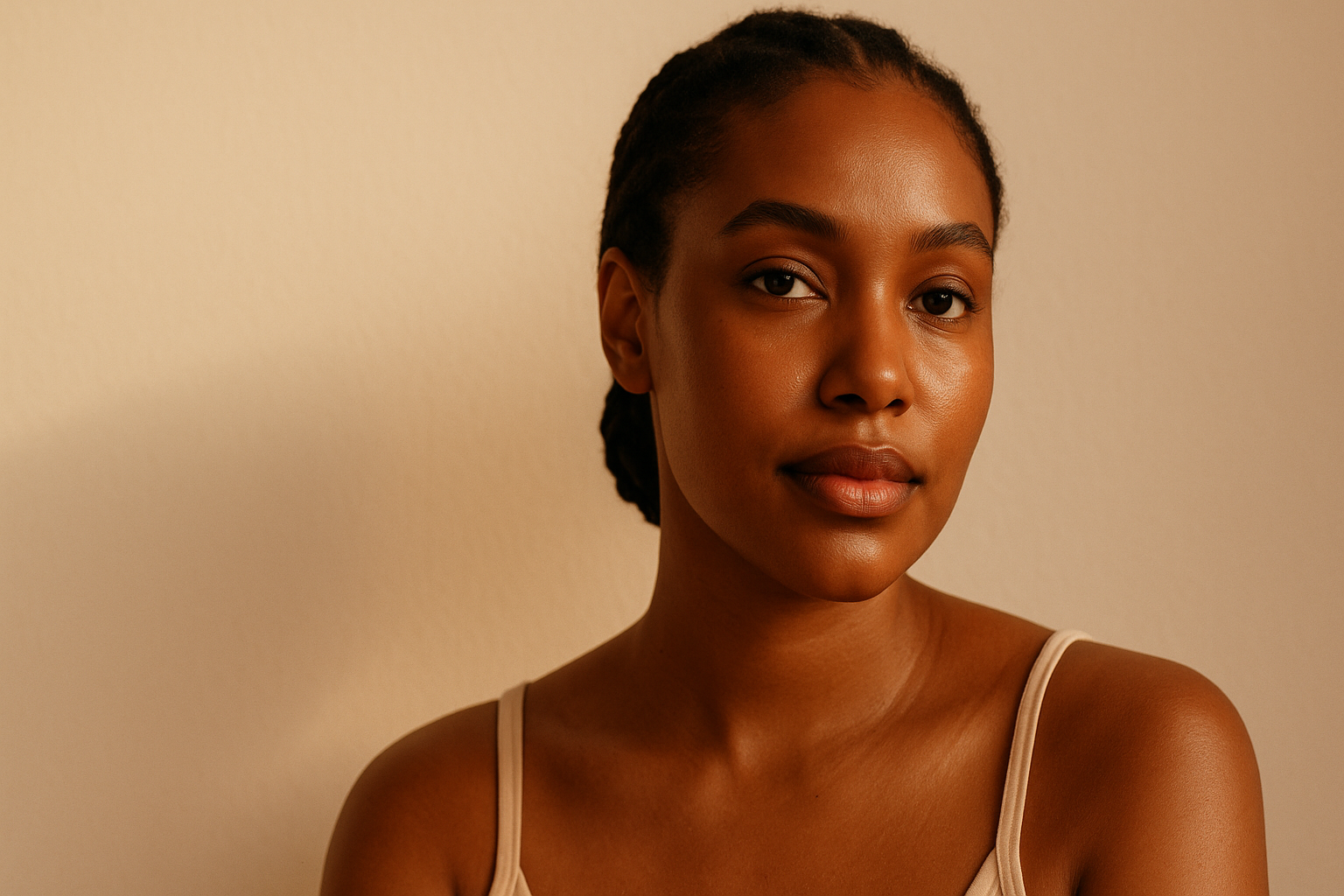
Skincare advice is mostly written for lighter skin. The active ingredients are usually the same — but the right starting concentrations, the irritation thresholds, the timeline expectations, and the specific findings that show up on melanin-rich skin are all different. Below are the questions we get asked most by users with Fitzpatrick IV–VI skin, answered straight.
Is skincare for dark skin really different from skincare for light skin?
Yes, in three specific ways:
- Pigmentation response to inflammation is stronger. Every breakout, ingrown hair, or harsh exfoliation can leave a dark spot — post-inflammatory hyperpigmentation (PIH).
- Baseline behaviors show differently. Redness shows as ashy gray rather than pink. Dryness can look dusty rather than flaky.
- The highest-leverage ingredients differ. Niacinamide, azelaic acid, tranexamic acid, and mandelic acid outperform glycolic and harsh retinoids on melanin-rich skin.
Why do my dark spots take so long to fade?
PIH on Fitzpatrick V–VI skin can take 6–24 months to fully fade — and that's with consistent treatment and sun protection. Three reasons:
- Deeper skin produces more melanin in response to inflammation, so the pigment deposit is denser.
- The pigment can sit deeper in the dermis, so brightening agents must penetrate further.
- Even small amounts of UV exposure re-trigger melanocyte activity and reset the clock.
Daily SPF is non-negotiable, and patience is required. Full breakdown on why dark spots stick around.
Is retinol safe for dark skin?
Yes, but the starting protocol matters. Start with 0.25% encapsulated retinol or 0.5% retinaldehyde, applied 2 nights per week, with a "sandwich" technique (moisturizer, then retinol, then moisturizer) to buffer absorption. Build to nightly only after 8–12 weeks of tolerance. Skip days when you exfoliate. Daily SPF is non-negotiable. Bakuchiol is a gentler alternative if retinol triggers PIH on your skin. Never start at 1% retinol on Fitzpatrick V–VI.
What is the best brightening ingredient for dark skin?
For most people:
- Tranexamic acid (3–5%) — safest and most effective on melanin-rich skin. Full guide.
- Azelaic acid (10%) — brightening + anti-inflammatory. Pregnancy-safe. Pregnancy notes.
- Niacinamide (5–10%) — barrier strengthener that also brightens. Niacinamide guide.
- Vitamin C (10–15% L-ascorbic acid) — morning brightener. Vitamin C on dark skin.
- Hydroquinone — most potent but should be cycled (3 months on, 3 months off). When to use hydroquinone.
Skip strong glycolic acid. Use mandelic acid or PHAs instead.
Why does my skin look ashy or gray after using moisturizer?
Two usual causes: residue from an inadequately absorbed moisturizer (often when the formula is too occlusive for your barrier state), or visible dehydration showing through underneath. Try a humectant-first approach — a hyaluronic acid or glycerin serum on damp skin, then a thinner cream rather than a thick ointment. If ashiness persists, weekly gentle exfoliation may help.
Can I use chemical exfoliants on dark skin?
Yes — but choose the right family.
- PHAs (gluconolactone, lactobionic) — gentlest starting point.
- Mandelic acid — gentlest AHA, larger molecule. Full guide.
- Salicylic acid 0.5–2% — safe for acne-prone melanin-rich skin.
- Glycolic acid 10%+ — leading cause of PIH on Fitzpatrick V–VI. Skip.
Start at 2–3 times weekly. Never daily. Always pair with daily SPF. AHA vs BHA vs PHA breakdown.
Is sunscreen really necessary on dark skin?
Yes — but for reasons that go beyond sunburn risk. Melanin gives some baseline UV protection (Fitzpatrick V–VI naturally sit at roughly SPF 13 equivalent), but it is not enough to prevent UV-triggered hyperpigmentation, premature aging, or skin cancer. The dominant skincare reason for SPF on dark skin is preventing the re-darkening of existing PIH and melasma. Without daily SPF, brightening treatments are fighting a losing battle.
What sunscreens don't leave a white cast on dark skin?
Modern chemical sunscreens (avobenzone, octocrylene, Tinosorb S) leave no cast at all. Mineral hybrid formulas with sheer zinc or micronized titanium dioxide also work — look for "tinted" or "sheer" formulas designed for deeper tones. Korean and Japanese brands lead the category. Detailed brand guide.
Does diet affect dark skin more than light skin?
Diet affects everyone's skin similarly — the difference is what shows up visibly. Inflammatory triggers (high glycemic foods, dairy for some people, alcohol) cause breakouts on any skin tone. On Fitzpatrick V–VI, those breakouts leave PIH that persists for 6–24 months. So the dietary stakes are higher on melanin-rich skin because the consequence of a breakout outlasts the breakout itself. Focus on consistent low-glycemic eating, hydration, and identifying personal triggers via a journal.
Why does my skin react to so many products?
Three likely causes:
- Barrier compromise. Repeated harsh actives have stripped your barrier — even mild products now feel irritating.
- True sensitization to specific ingredients — common triggers include essential oils, fragrance, certain preservatives.
- Layered actives interacting. Retinol + vitamin C + acid + benzoyl peroxide is too much for any skin.
Strip back to a simple routine (gentle cleanser, basic moisturizer, SPF) for 4 weeks. Then add one active at a time. Observe skin response. Barrier repair guide.
What's the difference between dark spots, PIH, melasma, and freckles?
All four look like brown marks, but they have different causes and treatments:
- Dark spots — casual umbrella term, usually PIH or sun spots.
- PIH — follows a specific inflammation event (acne, ingrown hair, scratch).
- Melasma — symmetric brown patches, usually hormonal. Hyperpigmentation vs melasma.
- Solar lentigines — sun spots from cumulative UV exposure.
- Freckles — genetic, concentrated in sun-exposed areas.
Can I use ingredients meant for lighter skin if I have dark skin?
Mostly yes — with adjustments. The active ingredients themselves work on all skin tones. The difference is starting concentration and frequency. On Fitzpatrick V–VI, start at half the concentration recommended on the label, half the frequency, and build slowly. The risk with darker skin is not the ingredient — it's the speed of escalation. Aggressive ramping causes irritation, which causes inflammation, which causes PIH that lasts for months.
How long until I see results from a new dark skin routine?
Realistic timelines:
- 4–6 weeks — visible texture, hydration, and clarity improvements
- 8–12 weeks — early PIH fading begins
- 6–24 months — meaningful PIH fading on Fitzpatrick V–VI
- 6–18 months — melasma management (often recurs with hormonal events)
Set realistic expectations and use a tracking tool. Most users underestimate how much their skin has actually changed because gradual improvement is invisible day-to-day in the mirror.
Should I see a dermatologist or use a skincare app?
Both, ideally. A dermatologist is essential for prescription-strength treatments (tretinoin, hydroquinone, oral medications), procedures, and any concerning lesions. A skincare app is essential for tracking change over time, identifying patterns you wouldn't notice in the mirror, and getting tone-aware analysis between dermatologist visits (typically 6–12 months apart). The app and the dermatologist complement each other rather than replace each other. Bring scan history to your derm appointment — they can interpret patterns faster with visual longitudinal data.
Get the AI scan calibrated for Fitzpatrick V–VI
Lumière commits to a Fitzpatrick and Monk Skin Tone classification before interpreting any finding. PIH and PIE are surfaced separately. Free first scan. No card. No catch.
Get my free skin scan ✦