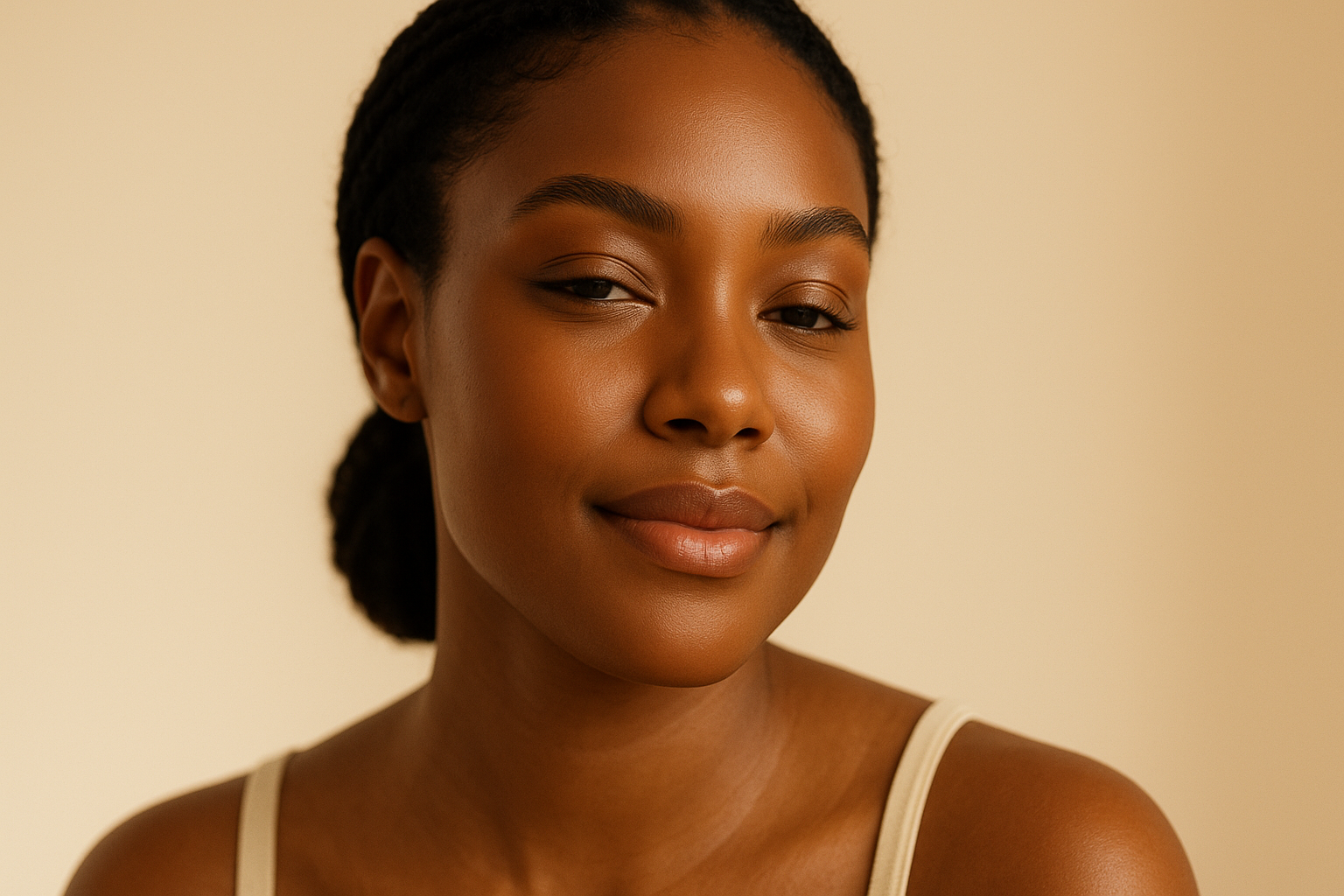
Chemical exfoliation gets reduced to a simple choice in most skincare content: "use an acid." Reality is more nuanced. The acid family you pick — and the specific molecule within it — changes everything about your skin's response. This matters more on melanin-rich skin (Fitzpatrick V–VI), where the wrong acid family at the wrong concentration is the leading cause of post-inflammatory hyperpigmentation in adult skincare routines.
The 3 acid families at a glance
| Family | Best for | Irritation |
|---|---|---|
| AHA (Glycolic, Lactic, Mandelic) | Dullness, dark spots, fine lines, surface texture | Moderate |
| BHA (Salicylic) | Acne, blackheads, oily skin, clogged pores | Moderate |
| PHA (Gluconolactone, Lactobionic) | Sensitive skin, barrier repair, first-time acid users | Very low |
AHAs — for surface concerns
Water-soluble. Work on the very top layer of skin. Dissolve the bonds holding dead cells together so they shed naturally.
- Glycolic acid — smallest AHA molecule. Most potent. Best for fine lines, dullness, and texture. Irritation risk is real.
- Lactic acid — larger than glycolic. Adds hydration. Good middle option.
- Mandelic acid — largest AHA molecule. Gentlest. Best for sensitive skin and Fitzpatrick V–VI. Mandelic acid guide.
- Malic, tartaric, citric — minor AHAs, usually formulation supports rather than primary actives.
BHAs — for pores and acne
Oil-soluble. The only acid family that can penetrate INTO pores and dissolve the sebum + dead-skin plugs that cause blackheads and acne.
- Salicylic acid — the BHA you'll see most. 0.5–2% is the OTC range. Anti-inflammatory in addition to exfoliating. Best for acne-prone skin, blackheads, oily T-zones.
- Betaine salicylate — gentler salicylic alternative used in Korean skincare. Less drying.
PHAs — for sensitive skin
Newer category. Larger molecules than AHAs. Penetrate much more slowly = less irritation, less photosensitivity, gentler exfoliation. Also have humectant properties (they pull water into skin).
- Gluconolactone — the most common PHA. Effective at 4–10%.
- Lactobionic acid — slightly stronger PHA with antioxidant activity.
- Galactose — newest PHA, antioxidant-focused.
Concentration guide
- AHA: 5–10% for daily use. 20–30% for at-home peels (weekly maximum).
- BHA: 0.5–2%. Higher concentrations don't perform better — they just irritate.
- PHA: 4–10%. PHA tolerates higher concentrations because of slow penetration.
The cardinal rules
- One acid family at a time when starting. Don't layer AHA + BHA + PHA in one routine.
- Daily SPF is non-negotiable on any acid. UV exposure on freshly exfoliated skin = more PIH.
- Pause acids before any waxing, dermal-needling, or laser treatment. Resume 1 week after.
- Don't combine acids with retinol on the same evening. Alternate nights.
Find out which acid family fits YOUR skin specifically
Lumière scans your skin and tells you whether PHA, mandelic, lactic, glycolic, or salicylic is the right starting point for your barrier state. Free first scan.
Get my free skin scan ✦