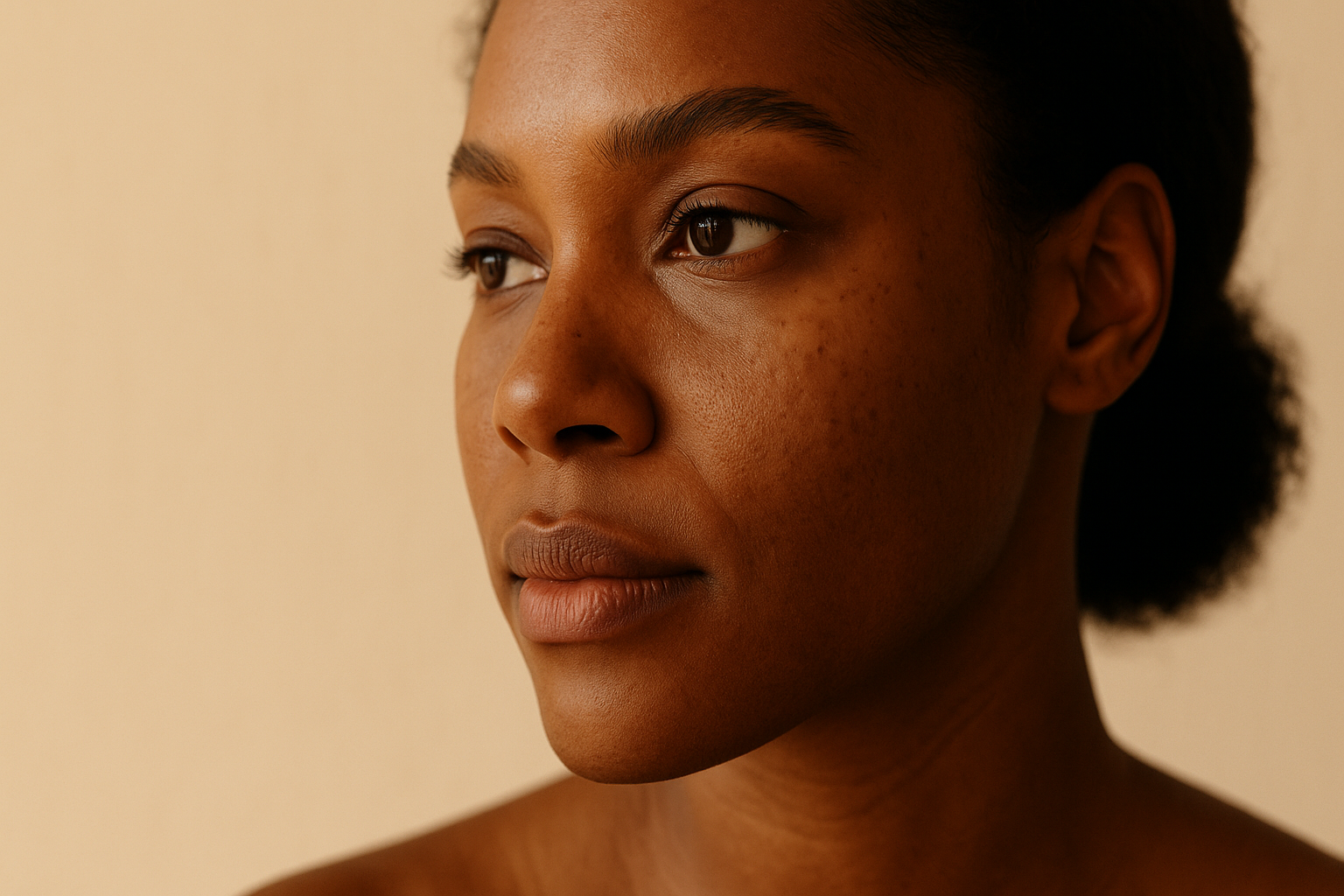
If you've been treating dark spots and nothing is working, there's a good chance you're treating the wrong condition. On melanin-rich skin, "I have dark spots" is the equivalent of saying "I have a stomach ache" — true, but not specific enough to fix.
There are at least three things that can produce brown patches on Fitzpatrick V–VI: PIH (post-inflammatory hyperpigmentation), PIE (post-inflammatory erythema), and melasma. We've covered PIH vs PIE separately. This piece is about the most confused pair: hyperpigmentation (specifically PIH) vs melasma.
The 3-second visual diagnosis
Look at the affected area in good natural light. Ask yourself three questions:
- Shape: Are the marks individual spots sitting in specific locations (like where pimples were)? That's hyperpigmentation. Are they map-like patches with irregular borders, often symmetric across both cheeks or forehead? That's melasma.
- Trigger memory: Can you remember a specific injury or breakout that preceded each mark? Hyperpigmentation. Did the patches appear during pregnancy, after starting birth control, or during a season of intense sun? Melasma.
- Border: Are the edges sharp and well-defined? Hyperpigmentation. Soft, blurry, fading gradually into surrounding skin? Melasma.
What each actually is
Hyperpigmentation (PIH)
PIH is your skin's response to injury. Acne, ingrown hairs, eczema flares, mosquito bites, picking, friction — any inflammation event triggers melanocytes to dump extra melanin into the area. The result is a brown or black mark that outlasts the original lesion by weeks to months.
On Fitzpatrick V–VI, PIH is the dominant kind of dark mark you'll see. Because there's more baseline melanin activity on melanin-rich skin, the post-injury pigment cascade is more vigorous. A small breakout that would leave a faint red mark for two weeks on lighter skin can leave a dark brown spot for six months on darker skin.
Melasma
Melasma is a chronic pigmentary disorder driven primarily by hormones and triggered or amplified by UV light. It tends to appear on the upper lip, forehead, cheekbones, and bridge of the nose — almost always symmetric (both sides of the face have matching patches).
Three common triggers: pregnancy (so common it's nicknamed "the mask of pregnancy"), combined oral contraceptives, and chronic sun exposure. The melanocytes in melasma are overactive, and once they're in that state, they tend to stay that way for years.
Why the treatments are different
This is where misdiagnosing one as the other costs you months.
What works on PIH
- Niacinamide 5% — blocks melanin transfer, strong evidence base. See our full niacinamide guide.
- Vitamin C (THD ascorbate 2–3% or L-ascorbic 5–10%) — inhibits melanin synthesis. See our vitamin C guide.
- Azelaic acid 10–20% — gentle tyrosinase inhibitor, also anti-inflammatory (treats the acne that causes PIH in the first place).
- Daily SPF 30+ — non-negotiable; UV reactivates melanocytes that just calmed down.
- Time — superficial PIH fades in 3–6 months with consistent care. Deeper PIH can take 12+ months.
What works on melasma
- Daily broad-spectrum SPF with iron oxides — visible light (not just UV) drives melasma. Standard chemical sunscreens are not enough. Iron-oxide-tinted mineral SPF blocks visible-light wavelengths that worsen melasma.
- Tranexamic acid (topical 3% or oral 250–500 mg/day) — the highest-evidence treatment for stubborn melasma. Oral form requires prescription and screening for blood-clotting risk; topical is OTC. Tranexamic acid guide.
- Azelaic acid 15–20% — effective and well-tolerated on Fitzpatrick V–VI; one of the safer melasma actives. Azelaic acid guide.
- Hydroquinone 4% (prescription, short-term cycles) — effective but use carefully on darker skin; can cause paradoxical darkening if overused.
- Avoid aggressive lasers and deep peels on Fitzpatrick V–VI — these treatments often produce PIH on top of the melasma, leaving you worse than before. If considering in-office treatment, find a dermatologist with deep experience in melanin-rich skin specifically.
The diagnostic trap most people fall into
Common pattern: you have melasma. You don't know it's melasma. You read that vitamin C fades dark spots, so you buy a 20% L-ascorbic acid serum. You use it for 4 months. Your barrier is now irritated from the low-pH formula, your melasma hasn't budged because vitamin C alone doesn't reach dermal pigmentation, and you've also developed fresh PIH on top of the melasma from the irritation. Now you have two problems and a busted skin barrier.
This is why diagnosis comes first. Throwing more product at darker spots without knowing which condition you have is the most expensive way to make slow progress.
Can you have both?
Yes — and on melanin-rich skin, it's common. A person can have hormonal melasma across both cheeks AND scattered PIH from old breakouts in the same area. The visible result looks like one big pigmentation problem. In reality it's two different problems requiring overlapping but distinct treatment.
A good rule: treat melasma first (it's the more stubborn condition). Once melasma is under control, the PIH usually responds well to a simpler routine.
Get a real diagnosis without a dermatologist visit
Most dermatology offices charge $150–300 just to identify what kind of pigmentation you have. That's a high bar before any actual treatment starts. Lumière scans your skin and identifies the specific pigmentation patterns — PIH, PIE, melasma, sun spots, freckles — in 30 seconds. Free first scan.
Find out exactly what kind of dark marks you have
Lumière scans your skin and tells you whether you're treating PIH, melasma, or both. Calibrated for Fitzpatrick V–VI from day one. Free first scan, no card required.
Get my free skin scan ✦Frequently asked questions
Does melasma go away on its own?
Sometimes. Pregnancy-triggered melasma often fades 6–18 months postpartum without treatment. Birth-control-triggered melasma may improve after stopping the medication. Sun-driven melasma rarely resolves without intervention — once the melanocytes are in the overactive state, daily SPF + active treatment is needed to bring them back down.
Can I use vitamin C and azelaic acid together?
Yes. They have different mechanisms (vitamin C inhibits tyrosinase; azelaic acid inhibits tyrosinase plus reduces inflammation). Use vitamin C in the morning, azelaic acid at night, or layer them at the same time of day if your skin tolerates it.
Is melasma genetic?
There is a genetic component. Up to 50% of melasma patients have a first-degree relative with melasma. If your mother or sister has melasma, your risk is higher — which is one more reason daily SPF starts in your teens, not your 30s.