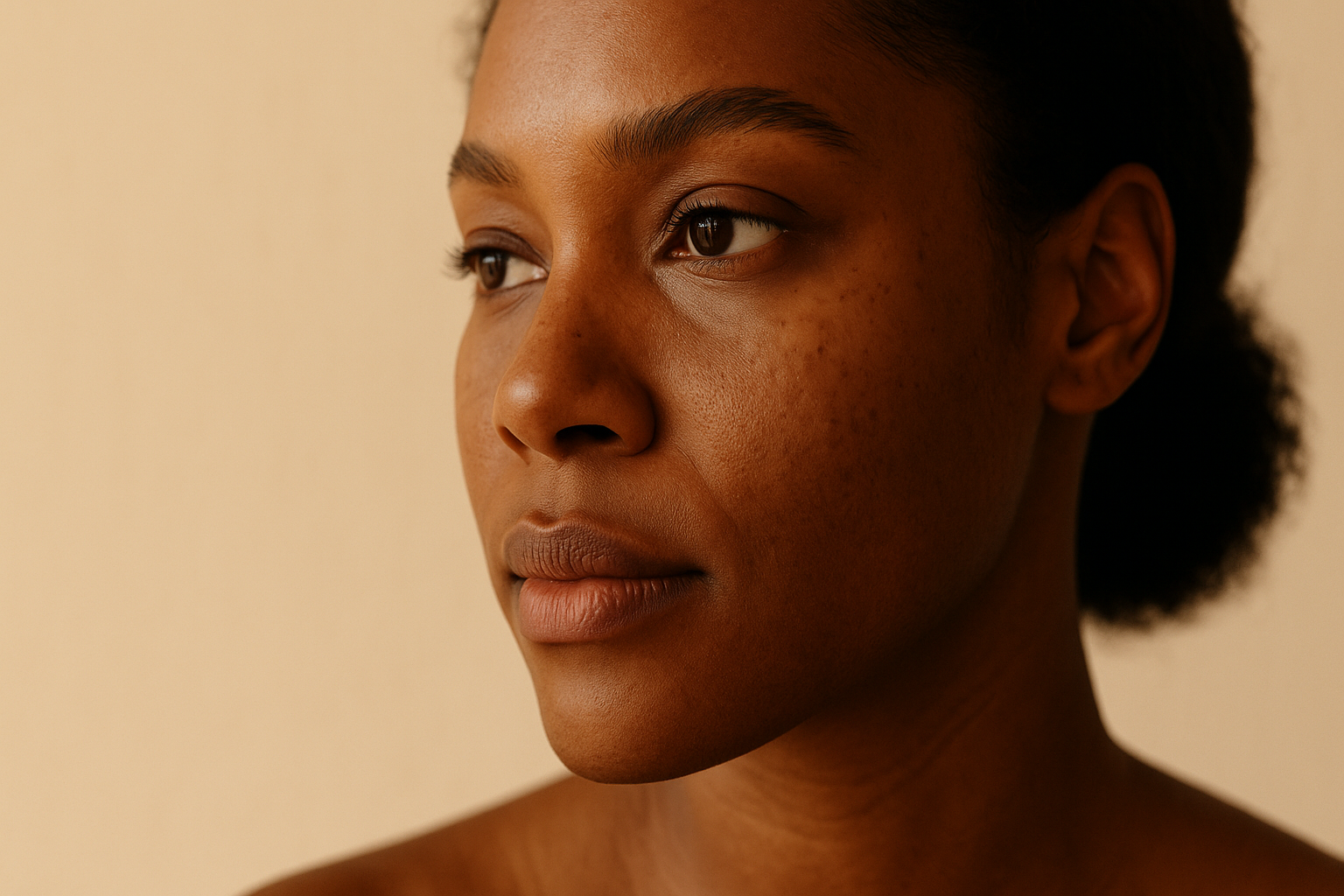
The Fitzpatrick skin type scale is the most-cited classification in dermatology — and one of the most misunderstood by consumers. Know your Fitzpatrick type and the skincare advice you read online suddenly comes with a calibration step. Below are the questions we get asked most about it.
What is the Fitzpatrick skin type scale?
A six-category classification of skin developed in 1975 by Dr. Thomas Fitzpatrick at Harvard. It groups skin into Types I through VI based on how it responds to UV exposure — does it burn, does it tan, what is its baseline pigmentation?
- Type I — pale white, always burns, never tans
- Type II — fair white, burns easily, tans minimally
- Type III — light to medium, sometimes burns, gradually tans
- Type IV — olive/light brown, rarely burns, tans easily
- Type V — brown, very rarely burns, tans easily and darkly
- Type VI — dark brown to black, never burns, deeply pigmented
It's the foundation of nearly every clinical study on photoaging, photoprotection, and pigmentation.
What Fitzpatrick type am I?
Determine your type by visible skin tone and UV response — see the categories above. Most users land between two adjacent types; pick the closer one. Modern AI skin apps can classify you more precisely than a self-reported questionnaire, especially for Fitzpatrick V and VI where the burn/tan questions stop being differentiating. Detailed Fitzpatrick guide.
Is the Fitzpatrick scale accurate on dark skin?
It's the standard — but it's limited. Six categories cannot capture the full diversity of melanin-rich skin tones. A Fitzpatrick V can be anywhere from light-brown South Asian to deep-brown East African — that's enormous tonal variation reduced to one category. Modern skincare AI typically supplements Fitzpatrick with the Monk Skin Tone scale (10 tones, more granular on the darker end) and Individual Typology Angle (ITA) measurement (continuous numerical value).
What is the difference between Fitzpatrick and Monk Skin Tone scale?
Both classify skin tone but use different granularity:
| Scale | Categories | Best for |
|---|---|---|
| Fitzpatrick | 6 | UV response classification, clinical dermatology standard |
| Monk Skin Tone | 10 | Visible tone diversity, deeper-end granularity |
| ITA | Continuous numerical | Precise colorimetric measurement |
Monk 1–3 corresponds roughly to Fitzpatrick I–II. Monk 4–6 to Fitzpatrick III–IV. Monk 7–10 captures the deeper end (Fitzpatrick V–VI) with four levels instead of two.
Why does Fitzpatrick matter for skincare?
Because most skincare advice — ingredient concentrations, frequency, irritation thresholds, treatment expectations — was developed and validated on Fitzpatrick I–III skin. Applied unchanged to Fitzpatrick V–VI, that same advice causes irritation, post-inflammatory hyperpigmentation, and slower visible results. Knowing your Fitzpatrick type tells you to:
- Halve concentrations of glycolic acid and retinol when starting
- Expect dark spots to take 6–24 months to fade rather than 6–12 weeks
- Prioritize barrier-supporting ingredients over aggressive actives
Can my Fitzpatrick type change over time?
Slightly, with sun exposure. Your baseline Fitzpatrick type is genetically determined and stable through adult life. Cumulative sun exposure can shift visible pigmentation darker (more so on Fitzpatrick III–IV), and pregnancy or hormonal events can cause melasma that darkens parts of the face. But your fundamental classification — how your skin responds to UV — is fixed. The variability is in expression, not type.
Is Fitzpatrick still used by dermatologists?
Yes, universally. Every published study on photoaging, photoprotection, laser treatments, and pigmentation references Fitzpatrick types. The criticism — that it under-represents darker tones — is widely acknowledged, but no replacement has reached the same level of clinical adoption. Modern practice is to use Fitzpatrick as the categorical anchor and supplement with finer-grained tools like Monk or ITA for melanin-rich skin specifically.
What does Fitzpatrick 5 mean?
Fitzpatrick V (often written as "Fitzpatrick 5") describes brown skin that very rarely burns and tans easily and darkly. It includes a wide range of tones — from many South Asian and Middle Eastern skin tones to lighter African skin tones to many darker Latina skin tones. Visible characteristics: rich brown skin, often warm or olive undertones, minimal UV-induced burning. Pigmentation response is strong — Fitzpatrick V skin is highly prone to PIH after inflammation.
What does Fitzpatrick 6 mean?
Fitzpatrick VI describes the deepest skin tones — deeply pigmented brown to black skin that never burns. It includes most African, Afro-Caribbean, and some South Asian skin tones at the darkest end of the spectrum. Visible characteristics: rich dark brown to ebony skin with high melanin density. Fitzpatrick VI has the strongest pigmentation response of all types — even minor inflammation can trigger PIH that takes a year or more to fully fade. Daily SPF, gentle actives, and barrier prioritization are non-negotiable for this skin type.
Can I use ingredients differently if I know my Fitzpatrick type?
Yes — knowing your type changes the protocol:
- Fitzpatrick I–III: standard concentrations and frequencies usually work as labeled
- Fitzpatrick IV: start at 75% of labeled concentration, build to full over 8 weeks
- Fitzpatrick V: start at 50% concentration, 50% frequency, build over 12 weeks
- Fitzpatrick VI: start at 25–50% concentration, 2x weekly maximum, build over 16 weeks
The risk in all cases is irritation triggering PIH that outlasts the treatment benefit.
How does an AI app determine my Fitzpatrick type from a selfie?
Modern AI skin apps classify Fitzpatrick by analyzing visible skin pixel values in known tone-reference regions of the face (usually the inner cheek and forehead), normalizing for lighting and camera color profile, then mapping to Fitzpatrick categories using validated lookup tables. Some apps (Lumière included) additionally compute ITA (Individual Typology Angle) for a continuous numerical measurement, and assign a Monk Skin Tone value 1–10. The classification is anchored to peer-reviewed colorimetric frameworks, not heuristic guessing. How AI skin analysis works.
Is there a test I can take to find my Fitzpatrick type?
Yes — the classic Fitzpatrick questionnaire asks 10 questions about your hair color, eye color, freckling tendency, baseline skin color, and UV response (burning vs tanning). Your answers are scored and total points map to a Fitzpatrick category. The questionnaire is reasonably accurate for Fitzpatrick I–IV but tends to under-classify Fitzpatrick V and VI because the questions about UV response stop being differentiating in deep skin. A photo-based AI assessment is more accurate for melanin-rich tones.
Find your Fitzpatrick + Monk Skin Tone in one scan
Lumière classifies you on both scales before interpreting any finding. PIH and PIE separated. Free first scan.
Get my free skin scan ✦