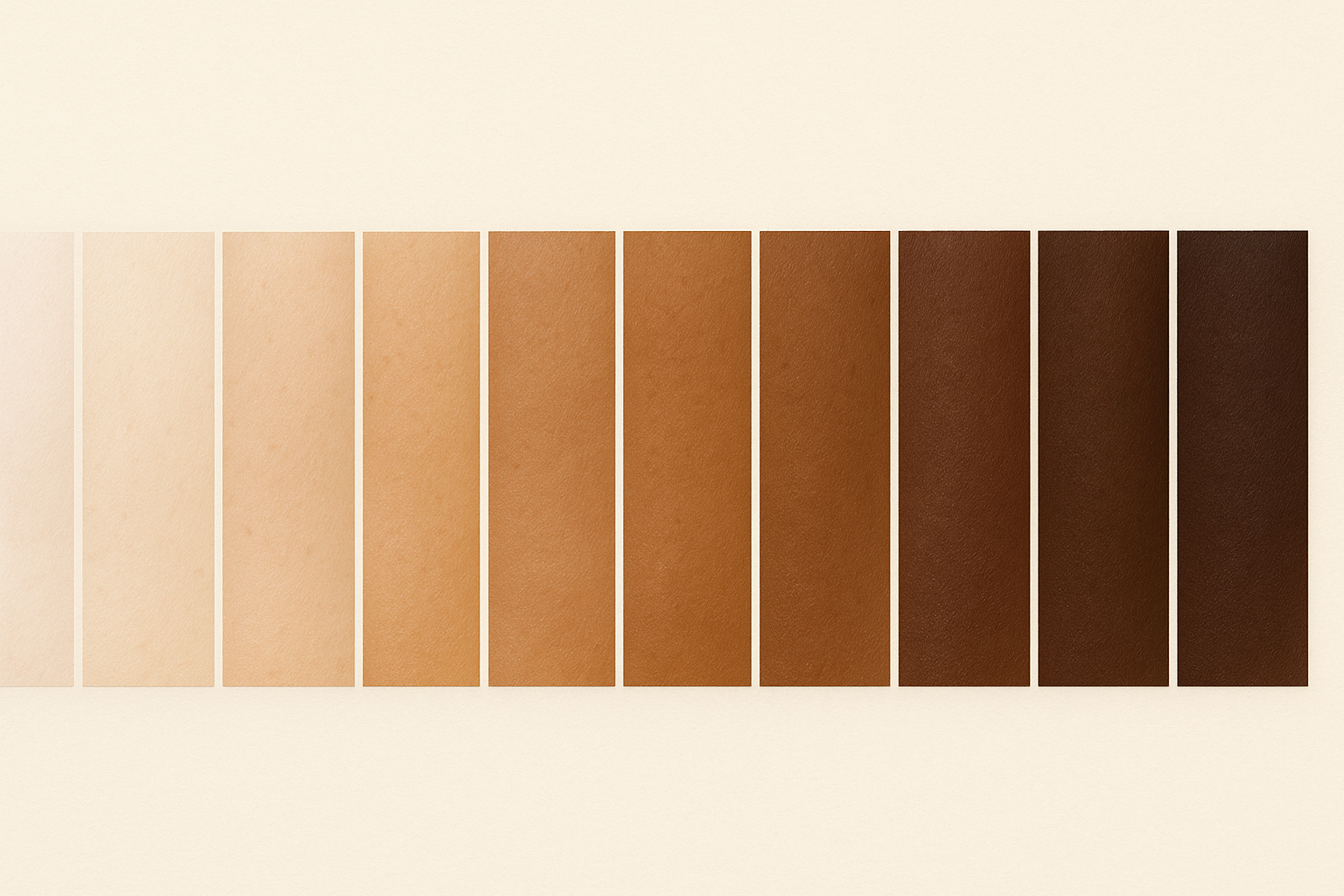
For 50 years, the Fitzpatrick scale has been the default way dermatology, skincare, and AI describe skin tone. It has 6 categories. Type 6 is supposed to cover everyone from medium-brown to the deepest brown — billions of people collapsed into one box.
In 2022, Dr. Ellis Monk at Harvard published a better framework: the Monk Skin Tone Scale (MST), with 10 evenly-distributed shades. In 2023, Google adopted it for their image AI. We use it at Lumière because if you're building anything for darker skin, the resolution of your classification matters.
What's wrong with Fitzpatrick
Fitzpatrick was created by Dr. Thomas Fitzpatrick in 1975 as a tool for predicting sunburn risk during medical UV therapy. It asks: how does this skin react to one hour of midday sun?
- Type I: always burns, never tans
- Type II: burns easily, tans minimally
- Type III: burns sometimes, tans gradually
- Type IV: burns rarely, tans easily
- Type V: very rarely burns, tans well
- Type VI: never burns, tans deeply
That's the entire scale. It has clinical use for UV therapy. It does not describe the actual range of human skin tones. Types V and VI bundle people whose skin can look completely different — like sorting all of the green spectrum into "green light."
How the Monk scale fixes it
Dr. Monk's scale has 10 evenly-spaced shades, designed to maximize coverage especially in the darker half of the spectrum. The first 5 shades cover what Fitzpatrick called Types I–IV (lighter tones). The next 5 cover what Fitzpatrick collapsed into V–VI — and that's where the real improvement is.
Quick reference:
- MST 1–2: very light to light
- MST 3–4: light to medium
- MST 5–6: medium to medium-tan
- MST 7–8: medium-deep to deep brown (most of Fitzpatrick V)
- MST 9–10: deep to deepest brown (most of Fitzpatrick VI)
Why this matters for AI skincare
If a skin AI is trained on a Fitzpatrick-labeled dataset, it learns that "Type VI" is one thing. When it scans someone at MST 7 vs MST 10, it returns the same generic Type VI recommendations to both — even though their skin barrier characteristics, melanin distribution, and hyperpigmentation risks differ meaningfully.
Calibrating an AI to MST means it can give MST 7 a different ingredient recommendation than MST 9 — because those skin tones actually respond differently. That's the wedge: depth of resolution matters when "darker skin" is your entire audience.
Where you'll see MST going forward
Google's AI image generation now uses MST internally. Search Engine algorithms reference it. Beauty brands like Topicals and Eadem reference it in product testing. Apple's Vision Pro accessibility features use it. Lumière scans report MST alongside Fitzpatrick because we want our users to know both — Fitzpatrick is what their dermatologist will use, MST is what tells them how precisely their products were tested for them.
Find out your Monk skin tone (and what it means for products)
Lumière scans your skin and reports your Monk tone with calibrated ingredient recommendations. Free first scan.
Get my free skin scan ✦