AI skincare apps went from novelty to mainstream in 18 months. The technology improved, the cameras on our phones got good enough, and a generation of users who grew up sharing selfies started asking why their skin app gave them the wrong answer. What follows is the straight read on the 12 questions we get asked most — by users, by press, and by skeptics.
Does AI skin analysis actually work?
Yes — for visible surface signs. Modern AI skin analysis uses computer vision to identify conditions like acne, hyperpigmentation, wrinkles, redness, and texture irregularities from a selfie. Studies show good accuracy on surface-level findings (typically 80–95% agreement with dermatologist assessment) for things you can see. AI cannot diagnose disease, biopsy a lesion, or replace clinical evaluation for anything suspicious. The right frame: AI is a tracking and triage tool, not a diagnostic instrument.
Is AI skincare accurate on dark skin?
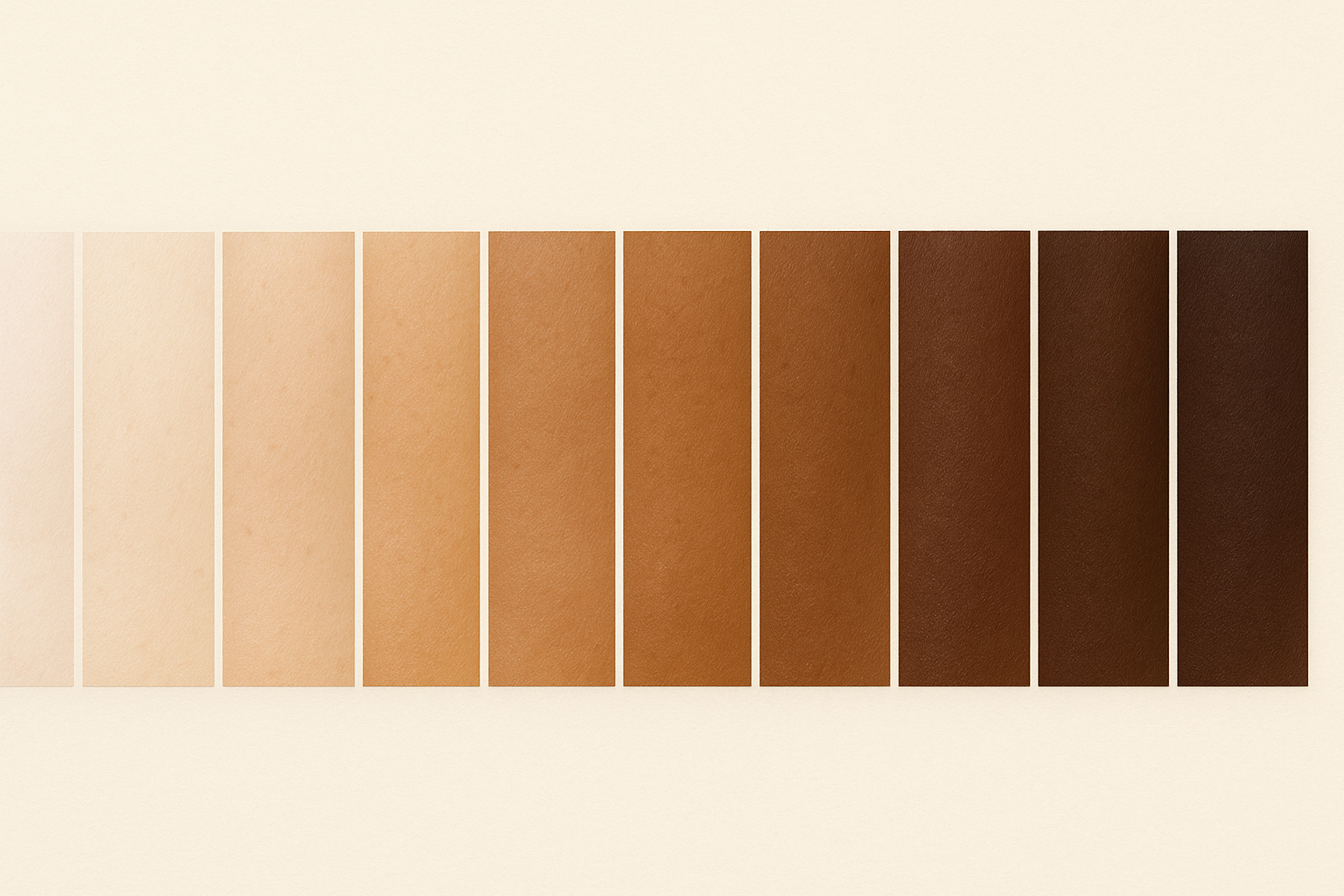
Most AI skincare apps perform worse on darker skin tones. This is a well-documented bias in dermatology AI overall — training datasets historically over-represent lighter skin (Fitzpatrick I–III) and under-represent deeper tones (Fitzpatrick IV–VI). The downstream consequence is real: a Black, Brown, or melanin-rich user opens a skin app and gets back generic or wrong results. Some apps explicitly calibrate for Fitzpatrick I–VI and the Monk Skin Tone scale to address this — every scan must commit to a tone classification before interpreting pigmentation, vascular signs, or barrier health. Read Lumière's methodology.
Can an AI skincare app replace a dermatologist?
No. An AI skincare app is not a medical device. It cannot diagnose disease, prescribe medication, perform biopsies, or evaluate moles for skin cancer. What it can do is help you track visible skin signs over time, surface patterns you would not notice in the mirror, and triage when something is worth a clinical visit. For anything that hurts, bleeds, changes shape, doesn't heal, or doesn't look right, see a board-certified dermatologist.
How accurate is an AI skin scan compared to a dermatologist?
Peer-reviewed studies on dermatology AI vs. dermatologists generally show 80–95% agreement on visible findings — acne grading, hyperpigmentation classification, wrinkle scoring. The agreement drops on rare conditions, on lower-quality phone-camera images, and on darker skin tones where the AI was trained primarily on lighter skin. AI is best understood as a supplement to clinical care, not a substitute. Used over time as a tracking tool, AI can outperform memory and self-perception — humans are notoriously bad at noticing gradual change in the mirror.
What does an AI skin scan actually detect?
A modern AI skin scan typically detects:
- Acne (papular, pustular, nodular, comedonal — separated by type and count)
- Post-inflammatory hyperpigmentation (PIH) — warm-brown melanin response
- Post-inflammatory erythema (PIE) — vascular post-acne redness
- Melasma patterns — symmetric pigmentation, often hormonal
- Fine lines, dynamic wrinkles, static wrinkles
- Enlarged pores, blackheads, whiteheads
- Baseline erythema and vascular reactivity (rosacea screening)
- Barrier compromise + dehydration lines
- Under-eye darkness type (vascular, pigmented, structural, or shadow)
- Skin tone via Fitzpatrick I–VI and Monk 1–10 classifications
Most apps produce sub-scores for hydration, clarity, glow, texture, and firmness, plus an overall health score.
Are AI skincare apps safe? Do they sell your data?
This varies by app. Read the privacy policy carefully. Things to look for:
- Are face photos stored in encrypted isolated storage, or used to train models?
- Are photos shared with advertisers, data brokers, or sold?
- Does the app comply with GDPR and CCPA, with named sub-processors?
- Can you delete your account and all associated data, in-app?
Lumière encrypts photos in transit (TLS) and at rest (AES-256), stores them in isolated AWS S3 buckets, never trains models on user photos, and never sells data. Read our full privacy policy. Other apps differ — always read the actual policy before granting camera access.
Is AI skincare better than a 10-step Korean routine?
Different tools for different jobs. A 10-step routine is a treatment protocol. An AI skin scan is a measurement instrument. The smart way to use both: use AI to identify what your skin actually needs, then build a routine (1 step or 10) targeting those specific findings. Without measurement, a 10-step routine is guessing. Without treatment, a scan is just data. The pair works.
How often should I scan my skin with an AI app?
Once per week is the sweet spot. Skin changes happen on a 4-to-6-week cycle (epidermal turnover takes 28–40 days). Weekly scans capture meaningful change without noise from day-to-day fluctuations (sleep, hydration, lighting). Daily scanning over-samples and produces noisy data; monthly scanning misses 4 weeks of trend signal. Most AI skincare apps build their longitudinal analysis around weekly cadence.
What is the best AI skincare app for dark skin?
Look for three things specifically:
- Explicit Fitzpatrick I–VI and Monk Skin Tone scale calibration. Every scan should commit to a tone classification before interpreting findings.
- Separate findings for PIH vs. PIE. Most apps conflate these into one finding; they need completely different treatments.
- Transparent methodology. The app should publicly document how it calibrates for melanin-rich skin, not just claim it does.
Lumière is built around exactly these three principles. Read the methodology.
How much does an AI skincare app cost?
The market splits into three tiers:
- Free with ads or affiliate commissions. Watch for: hidden push toward expensive partner products via commissioned recommendations.
- $5–10 per month subscription. Mid-tier — usually clean recommendations, often Pro features behind the paywall.
- $69–149 per year subscription. Annual pricing, usually with the deepest feature set.
Subscription-funded apps (where you pay the app, not the brands) tend to give cleaner advice since their incentives align with you instead of with retailers. Lumière is free to use, with an optional Pro subscription that's clearly disclosed.
Can AI predict future breakouts or skin changes?
Partially. With enough longitudinal data (typically 8+ weekly scans), AI can identify patterns that predict your specific skin's behavior — for example, that your clarity score drops 48 hours after a stress event, or that your barrier compromises when humidity drops below 30%. This isn't true prediction; it's pattern recognition on your historical data. The longer you use a tracking app, the more useful the predictive layer becomes.
Do AI skincare apps require a perfect selfie?
No, but lighting matters. The biggest accuracy drivers are:
- Even lighting (avoid harsh side-light or overhead shadows)
- No makeup
- No filter, no beauty mode
- Face fully visible (no hair covering forehead or cheeks)
- A recent phone camera (most flagship cameras from the last 4 years are sufficient)
Most modern AI skin apps run a quality check before processing and prompt you to retake if lighting or angle is unusable. You don't need a studio setup — natural window light works.
Try the AI skin scan calibrated for every skin tone
Lumière commits to a Fitzpatrick and Monk classification before interpreting any finding. PIH and PIE are surfaced separately. Free first scan. No card. No catch.
Get my free skin scan ✦